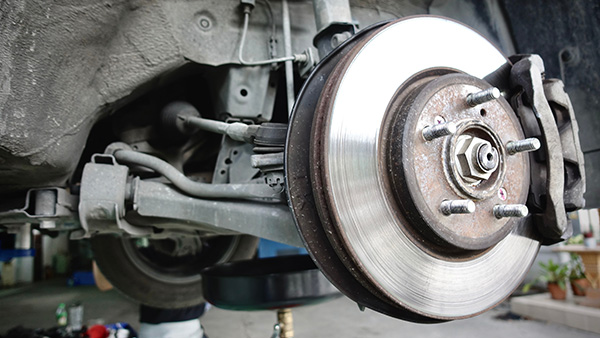
Winter driving asks more from the brake system. Cold mornings, wet roads, snow, and slick intersections can all make stopping conditions less predictable, so this is not the season to start with brake pads that are already close to worn out.
You do not need to wait for grinding or a warning light to find out how much brake life is left. Pad thickness, wear pattern, rotor condition, and how the brakes feel can tell us whether the system is ready for another winter or whether service should be handled first.
Brake Pad Thickness Gives Us the Best Starting Point
Brake pads wear a little every time you stop. As the friction material gets thinner, the remaining service life becomes easier to estimate.
At our shop, we measure the pads rather than trying to judge them through the wheel. We also compare the inner and outer pads because one can wear much faster than the other. If a pad is already getting close to its minimum thickness before winter starts, it makes more sense to plan the repair now than hope it lasts through several more months of bad weather.
Uneven Wear Can Mean the Caliper Is Not Working Correctly
All the pads on the same axle should wear at a reasonably similar rate. If one pad is much thinner, look for a mechanical reason.
A sticking caliper piston, seized slide pin, restricted brake hose, or rusty hardware can keep one pad against the rotor longer than it should. Replacing only the thin pad does not solve that problem. We check caliper movement and hardware, so the new parts don't wear out the same way.
Brake Noise Can Tell You the Pads Are Getting Low
Some brake pads use small wear indicators that create a high-pitched squeal when the friction material gets low. Other vehicles use electronic sensors that turn on a warning message.
Grinding is more serious. That can mean the friction material has worn away and the metal backing plate is contacting the rotor. If that happens, the rotor can be damaged quickly. A light squeak deserves a check, but a harsh grinding sound is a reason to stop putting off the repair.
Winter Makes Rotor Condition More Important Too
Good pad thickness does not help much if the rotors are badly rusted, deeply grooved, or heat damaged. The pads need a good braking surface to work against.
Road salt, moisture, and repeated winter temperature changes can worsen existing rotor corrosion. During an inspection, we check both sides of the rotor because the inner surface can be much more corroded than the side you can see through the wheel. We also measure thickness before deciding whether the rotor can stay in service.
Pay Attention to Pedal Feel and Braking Response
Your brake pedal should feel consistent from one stop to the next. If it suddenly feels soft, low, or takes more effort to stop the car, do not assume it is only because the pads are getting older.
Air in the hydraulic system, old brake fluid, leaks, caliper problems, or a failing master cylinder can all change pedal feel. We look at the complete brake system instead of replacing pads and hoping the pedal improves. Winter roads give you less room to deal with a brake problem that is already developing.
A Pull or Vibration Deserves Attention Before Snow Arrives
If the vehicle pulls to one side while braking, the brakes are not applying evenly. A sticking caliper, contaminated pad, tire problem, or suspension issue can all contribute.
A pulsing pedal or steering wheel vibration usually points to the rotors and wheel hubs. Uneven rotor thickness or runout can create a repeating vibration every time the brakes are applied. Fixing those issues before winter gives the vehicle a much more predictable feel when traction is already limited.
Do Not Base Brake Life on Mileage Alone
Brake pads do not wear out on a fixed mileage schedule. City driving, mountain roads, vehicle weight, towing, and driving habits can dramatically affect brake life.
One driver can get many miles from a set of pads while another wears through the same parts much sooner. Regular maintenance works better when we track actual thickness and condition from one visit to the next. That gives us a much better idea of whether the brakes can reasonably make it through another season.
Get Winter Brake Service In Denver, CO, With South Denver Automotive
If your brake pads are getting low, the brakes are noisy, or you are not sure how much life is left before winter, South Denver Automotive in Denver, CO, can check the pads, rotors, calipers, hardware, and brake fluid.
Schedule a brake inspection before cold, wet roads arrive, and make sure the system is ready for the months ahead.